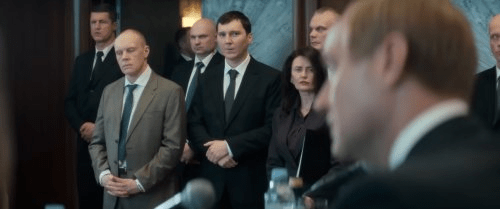
Examining the rise of an authoritarian dictatorship from the inside out, The Wizard of the Kremlin also technically comes from a novel of historical fiction—the 2022 work of the same name by Giuliano da Empoli, who wrote it from his own, but imagined, perspective. Its story concerns the presidency of Vladimir Putin, how it came to be and who, exactly, was responsible for its transition from politically convenient to the openly corrupt, intensely paranoid institution it is today. It is important, though, to clarify once again that this is a story and not a historical account.
As such, this is surprisingly absorbing stuff, following the fortunes of Vadim Baranov, a one-time television producer and accomplished stage director who became advisor to Putin in the early days of his discontentment with the outgoing regime of Boris Yeltsin and would eventually become yet another casualty in Putin’s paranoid fight against a system he felt was conspiring against him. It’s something of an intimate study of the most important political figures during this decade and a half of history. It’s also something of an epic, expansive in its view of a region in constant turmoil.
The charge here is that Putin’s reign—which continues even today, under the renewed scrutiny of their war with Ukraine—did not all come down to the efforts of a single man, but to the complicity of an entire ecosystem around him. At the top of that pyramid is Baranov, played by Paul Dano in one of three crucial performances in this ensemble. Soft-spoken but politically sharp, Baranov begins his journey in a youth spent quite aware of the political scene around him and deeply unhappy with whatever it’s becoming.
His journey from artist to producer of live and televised entertainment to close advisor to an obvious sociopath and, when they meet, director of the Russian Secret Service is an unnerving one to witness over the course of a couple hours, if only because it comes across as so unlikely. Something in Dano’s performance, which begins as reserved and regresses to become almost inscrutable, suggests that two things are true at once. One might be that Baranov never expected things to go this way.
The other, though, is that the man rather enjoys the suggestive power he initially has over the future prime minister, then president, of an unbelievably powerful country. That’s why the film’s first half, recounting Baranov’s journey with biographical attention, is so crucial to the later part of the story. We get to see a budding romance with a self-proclaimed revolutionary named Ksenia (Alicia Vikander), who goes down her own unpredictable path when their paths cross with political dissident Dimitri Sudorov (Tom Sturridge), and that entire chapter certainly informs Baranov’s later decisions, occasionally made in rebellion of his old life.
After all that, yes, Baranov meets Putin, who is played by Jude Law in a performance that completely ignores the real man’s Russian dialect in favor of the actor’s own British one but otherwise communicates through empty eyes that see nothing in front of him which he cannot control. It’s good work from a fine actor, tautening in tension as Putin’s initial aloofness shapes the political reality around him to mirror his own wishes. One chilling stretch sees him attempt to spin the sinking of a submarine, in which there might be survivors, by forcing his own inaction to work in his favor with the public.
The third important performance, by the way, comes from Will Keen as Boris Berezovsky, another actual historical figure slightly fictionalized to fit a dictated narrative. Those know a little about recent Russian history will know what happened to the man, and of course, the many questions surrounding his fate are once again raised. Keen is quite good here, too, painting the portrait of an intelligent, observant and fully cognizant cog in a machine that eventually escapes his own control.
There is something of a dryness to the way director Olivier Assayas (who also co-wrote the screenplay with Emmanuel Carrère) unfolds this story stubbornly in order, offering only a framing device involving Dano’s Baranov being interviewed by Jeffrey Wright’s Rowland as a way to tie this altogether. Still, The Wizard of the Kremlin is a credible and engrossing portrait of a kind of history—fiction at its core but, as with all fiction, containing kernels of sober truth.
Rating: *** (out of ****)


Leave a Reply