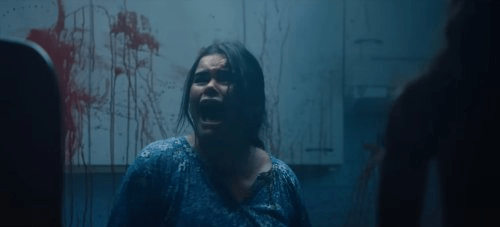
The social commentary driving Faces of Death is certainly not subtle, but this is an intelligent movie, both in what it’s saying and in the cold way writer/director Daniel Goldhaber is saying it. The title might be familiar to anyone who knows of the fairly obscure but cultishly admired curio, which really did cause quite a stir among moviegoers in 1978 for the way it purported to feature real videos of graphic death. Here, it has caused, well, a different kind of stir for a serial killer who decides to recreate scenes from the film—but with real victims, real weapons and real carnage.
In case the idea behind this set-up isn’t obvious by simply reading such a synopsis, Goldhaber goes further by giving us a protagonist whose literal job is to moderate the content of a video-sharing platform. We get a sense of what that job is like for Margot (Barbie Ferreira), and that doesn’t only mean what it’s like for her in the psychological sense. The higher-ups are quite particular about the non-disclosure agreement that is signed upon being hired, and the content to be either allowed or flagged for removal truly runs the gamut: Violence is ok, for instance, if the moderator deems it to be fake, but any and all content related to drug use or sexual material is not—even if it’s about preventing the former or education about the latter.
Margot’s bosses, represented here by Josh (Jermaine Fowler), are also not really interested in moderating the type of content that might spark an investigation—which would attract the police, which would reflect poorly upon the company. It’s a lose-lose world, and Margot, who was hired under particularly difficult personal circumstances, very much needs this job. Not long ago, she was the “star” of a video that went viral for genuinely tragic reasons—a social-media trend involving a dance and a train track that resulted in the death of her sister.
To this day, she’s still known as “Train Girl,” an identity that immediately triggers bad memories and inspired her complete abandonment of social media. Ferreira’s performance here is smartly keyed into the past trauma of the character, who uses her job as content moderator, perhaps, to exorcise the image of her sister’s death—which, to be quite clear, was instantaneous, gruesome and right in front of her—from her everyday life. Such things are easier said than done, of course, which actually plays a role in the third-act frenzy to escape the clutches of the serial killer.
He has a name, but Dacre Montgomery’s icy, bizarre performance wholly distracts from whatever it is. The man stalks moderately famous people online, finds out where they are in person, and drugs or otherwise incapacitates them for the purposes of staging the sequence that will end in their death. His victims here include a social-media influencer (played by Josie Totah) and a news personality (played by Kurt Yue), whose son (played by Ash Maeda) is an unfortunate witness and captive, as well.
The film’s narrative is split—sometimes literally, by way of a split screen—between the killer finding his latest victim and Margot trying to rally support from somebody, anybody, to hear what she’s found out. Her attempts to go to the police or to appeal to her bosses obviously go badly, and even her roommate Ryan (Aaron Holliday) warns her to be careful about causing a ruckus. She eventually moves to online spaces and a grassroots approach to carry out her own investigation.
The killer, though, is also smart, unwaveringly patient and absolutely ruthless, which means we get a third act that brings these two characters together in a sort-of-predictable way. The film’s ideas lose a bit of their coherence when this happens, but that’s all right in the long run. The ideas still guide the action and inform the violence of that climax, which rather admits that such violence is inevitable.
Even that simple idea is a chilling one, which means that Faces of Death, though prone to undermining its ambitions by simplifying everything to a chase and a villain’s comeuppance, still works as a dark fable about our violence-obsessed culture. Again, it’s not subtle, but it sure is pointed and, in this context, quite intelligent.
Rating: *** (out of ****)


Leave a Reply