Colby Day’s screenplay for In the Blink of an Eye is obviously ambitious, covering narrative ground that spans nearly 2,000 years of history, as seen through the eyes of five people split between three timelines. The first perspective is of a woman in the Paleolithic period, where the early humans became known as “Neanderthals,” and the third perspective, chronologically speaking, is 400 years into our own future, where a woman researches plant life to find some answers about human aging. The middle story, then, is a link in the chain in many ways, providing a clue about what bridges millennia of history.
Taken on their own, these are effective and affecting stories of love, connection, tragedy and, generally speaking, whatever makes humans the species that they are. Melded together like this, director Andrew Stanton stumbles at tying them all together in a thematically coherent way. The fact of the matter is, as carefully woven as each story on its own turns out to be, there is little that truly connects them specifically, so that we’re cutting between moments of tragedy and levity that are unevenly presented as a single unit of storytelling.
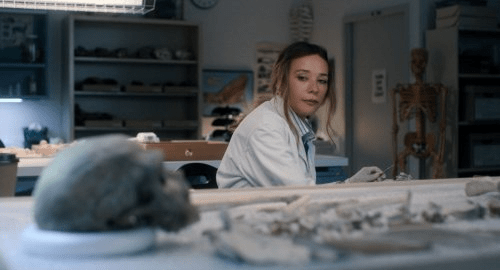
That middle story, for instance, is the most relatable and, probably, the most affecting one here, because its internal conflict is the one that is most recognizable: Claire (Rashida Jones) is an anthropologist on the cusp of a major discovery that, as she tells her mother over the phone one day, might be the key to discovering the elusive “missing link” that has been a scientific holy grail for a couple centuries now. On a more personal level, she’s trying to figure out her feelings for fellow science professional Greg (Daveed Diggs). When her mother gets sick, priorities shift, leading to Claire questioning how serious things really are between her and Greg.
Turning this story more insular is a fine idea in theory, but it also suffers from the problem that plagues the rest of the production: that there simply is not enough time spent with these characters to care about their troubles below the surface melodrama of it all. Jones and Diggs are fine enough, especially in a heart-to-heart where Claire speaks her mind and unearths some deep feelings almost impulsively. The fact remains, though, that it is melodrama, and the lack of genuine characterization means this whole affair is also shallow.
There are hints of something better in the earliest story among these three, which follows that Paleolithic family, consisting of Thorn (Jorge Vargas), his mate Hera (Tanaya Beatty), and their child Lark (played at two different ages by Skywalker Hughes and Tatyana Rose Baptiste). Together, they discover the advent of fire and tools and the family unit. They also encounter heartbreak when a new pregnancy of Hera’s potentially goes awry, and the actors are wholly committed to the challenge of building characters out of non-subtitled language and primitive movement.
Out of the three, this story is the one most directly about connection to others, as this early civilization designs the concept of marriage as both a transaction and the way to propagate a species. In the far future, though, there is Coakley (Kate McKinnon), an astronaut/scientist who has gained the ability to live for hundreds of years, whose AI co-pilot (voiced by Rhona Rees) is her only companion. Coakley searches for a way to keep civilization going, battling the elements that endanger her ship and the plant life aboard it.
Separately, the stories ably juggle their respective tonal mixture of deep despair and desperate optimism, weaving tales that are meant to inspire and move us. That works reasonably well at the best of times, but at only 90 minutes (minus credits), In the Blink of an Eye only shortchanges all those stories by mushing them together in time for an ending montage that means to yank those tears from our eyes by any means necessary—good taste be damned.
Rating: ** (out of ****)


Leave a Reply