In the year 2000, a pair of best friends ventured into the forests on Vancouver Island, never to be seen again, and as soon as their motivation becomes clear, we nod with a sense of recognition and understanding about what drove these two men—including, of course, one named Matthew Nichols—into those woods. After all, a year before that, following a wildly popular marketing campaign, a certain horror film came out and, essentially, created the “found footage” craze. In case we weren’t already thinking about The Blair Witch Project upon reading a quick synopsis of this movie, Hunting Matthew Nichols just goes ahead and makes that connection for us.
That simple act both separates and slightly elevates co-writer/director Markian Tarasiuk’s film from the deluge of similarly inspired “found footage” fare that followed the earlier movie and, one after the other and with very few exceptions, failed to match those expectations. To be fair, this one doesn’t come close to that quality, either, if only because, once we get to the actual details of the possibly supernatural events that led to the disappearances, they’re the typical stuff of this kind of movie. Still, the journey to get there is constantly evolving and introducing new ideas.
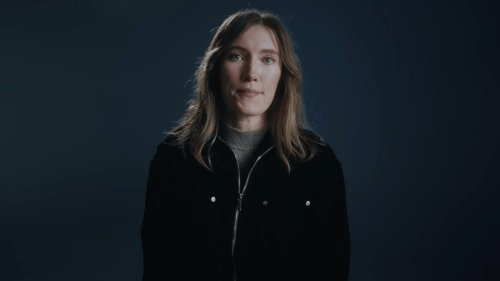
A messiness of purpose and approach is also present that, perhaps, limits the cumulative effect of all this, and that might be located in the fact that we’re always aware of the actors and the performances they’re giving here. Miranda MacDougall, for instance, plays Matthew’s younger sister Tara. For all the desperation that Tara shows in her talking-head “interviews” and in her own interviews with other figures in her life and the investigation, the actress isn’t exactly a naturalistic presence.
Quibbles like this eventually either disappear or, at the very least, become less and less meaningful as the investigation goes forward, with Tara providing some of the biographical details of her and Matthew’s (James Ross) childhood and the events that led to his and Jordan’s (Issiah Bullbear) decision to go into that forest. Yes, exactly as it sounds, this early section of the movie operates quite like one of those true-crime documentaries that are essentially ubiquitous in our culture now. Matthew and Jordan loved The Blair Witch Project, and their entire motivation was to remake it, shot-for-shot.
The problem, of course, with that decision is at the center of the mystery that surrounds their actual disappearance, and several metatextual layers exist here to sell the illusion. Some of them are subtle, like the fact that the opening credits announce this to be a “Tara Nichols Production,” and some are more obvious, such as Tarasiuk casting himself and the cameraman, Ryan Alexander McDonald, as versions of themselves named Markian and Ryan, who serve as director and cameraman on the documentary-within-the-movie.
The movie has a healthy dose of skepticism about itself, its genre, and even its subjective inspiration, by the way. At one point, Tara discovers reasons to believe that the now-former police detective (played by Christine Willes) might have hidden evidence from Tara and her crew that turn out to be a key piece of the jigsaw puzzle. At another point, when all three members of this grassroots crew have watched some crucial video playback of an abandoned video camera, it simply raises more questions than it provides answers.
Could these young men have faked their disappearance by staging it all meticulously, or would they have even had that capability more than two decades ago, armed with only that video camera and no other obvious resources? Even if they did fake it, how did the camera end up in the creepy, abandoned house, located right in the middle of the woods, where no other sign of their presence was detected? A lot of this moves aside for what’s really going on at the heart of this mystery, which is resolved with a lot of fairly typical scare tactics and some predictable revelations.
They serve their purpose, though, and Hunting Matthew Nichols, for its flaws and limitations, is more fascinating for the way it explores that purpose. The movie works better in that mode than as a piece of horror filmmaking, but it does, indeed, work quite well.
Rating: *** (out of ****)

 Joel on Film
Leave a comment