Project Hail Mary gets off to such a rough start that one wonders whether directors Phil Lord and Christopher Miller, in bringing Andy Weir’s 2021 novel to the big screen, really understood the human elements of this story. Then again, at the heart of this story is a most peculiar type of relationship, which screenwriter Drew Goddard (adapting his second Weir novel, after 2015’s The Martian) fully communicates, helped tremendously by star Ryan Gosling and, well, another participant. We’ll get to that second character in a minute, but until then, it’s important to explore why the film works as well as it often does and, occasionally, doesn’t.
Gosling plays Ryland Grace, a middle-school science teacher and molecular biologist whose comfortable life spent in the company of the kids in his class is upended by a gravely important, world-saving priority shift. A substance of an extraterrestrial nature is discovered along what becomes known as the “Petrova Line,” and upon being named “Astrophage,” more discovery shows that it’s consuming the power of our sun. The effect will be a catastrophic global cooling that will likely eliminate about half of Earth’s population within 30 years—unless knowledgeable people come together to solve the obvious problem.
That is, as readers of the novel will remember, only the background of the story, as Grace is approached by covert government forces, led by Eva Stratt (Sandra Hüller), to assist with the science part of the mission planning. An unconscionable tragedy just when deployment is poised to take place necessitates Grace’s direct involvement in the mission, placed in a coma to survive the trip and awakening some time later to discover he’s the only survivor out of the three sent to investigate the source of the Astrophage (Ken Leung and Milana Vayntrub play the other two in flashbacks).
It is unfair, perhaps, to compare formats of artistic expression, but it must be stated that these early stretches of the film pale in comparison to the novel, in which Weir knew instinctively that a lightness and levity were needed to cut through the severity of the entire scenario. In movie form—at least, as directed by Lord and Miller—the scenes ride a wave of burdensome humor, particularly underlined by how Grace’s recovery from his coma becomes an extended physical comedy routine for Gosling to perform (this is also true later, when Grace dons a spacesuit and it’s slightly funny and goofy for some reason). His rendezvous with Stratt and series of meetings with the world’s military leaders are also excuses for Grace’s aloofness and social awkwardness to come on strongly.
It’s the wrong tonal decision entirely and meshes weirdly with the scenario’s severity, rather than complementing it. Perhaps that has to do with Goddard’s challenge of adapting a novel driven by science, but we’re also getting too in-the-weeds about the film’s admitted shortcomings for such a positive review. That’s when we meet Rocky.
Rocky is the other character here, and although the pronoun “he” is likely reductive in the extreme, he’s brought to life by way of a seamless melding of sly digital effects and the inspired vocal and puppeteering performance of James Ortiz. The two meet when Grace’s ship, the Hail Mary, comes within the proximity of Rocky’s ship—a masterpiece of spiky, essentially inhuman art direction on the outside alone, which makes our late journey inside the thing worth the wait and our investment. Rocky, so named for his stony appearance, is Grace’s mirror in many ways—resourceful and frighteningly intelligent, immediately able to deduce things about human behavior and understanding of science and mathematics.
Any and all of our qualms about the early treatment of this story dissipates upon the moment Grace and we meet Rocky, who has his own tragic story involving the Astrophage and reveals a depth of emotion that Grace can immediately empathize with and understand. The pair begins to bear out scientific strategy, both to gather information about the Astrophage and to understand why Tau Ceti—an actual star, by the way, that is actually 12 light-years from Earth—is the only star not to be affected by the little “Space Dots.” Even the film’s big sense of humor steadies itself when focused on these two, which is thankfully for such a massive portion of the film’s two-and-a-half hours that there’s little to distract from it.
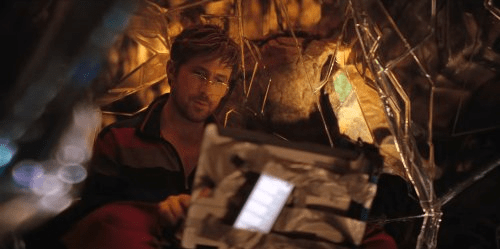
The production is an immaculate crossroads between some truly inspired digital effects and entirely practical ones (including Grace’s ship, which is clearly a tangible set, and the makeshift passageway that leads to Rocky’s, which has cave-like qualities made warmer somehow). The film also retains the inexplicable experience of the novel’s final scenes, the details of which won’t be revealed here for the benefit of the viewers going in blind. Let’s only say it’s a lot less about the scramble to save the day than it is about a kind of rebirth for our pair of heroes.
It makes the missteps of the film’s early stretches a lot easier to forgive, if not so easy to forget in the long run. Project Hail Mary gets the most essential function of its story correct, which is to say that, as a paean to scientific proceduralism and as a buddy comedy of a most unique variety, the film is particularly good—with reservations that do remain.
Rating: *** (out of ****)

 Joel on Film
Leave a comment