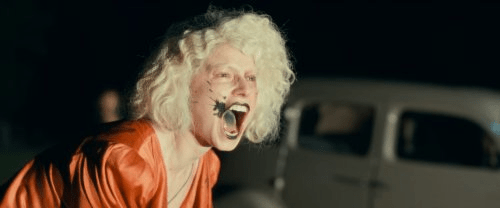
Here is the story of the bride of Frankenstein(’s monster), and writer/director Maggie Gyllenhaal wants us to be quite sure of whom her story centers—constantly, in fact. The exclamation point in the title of The Bride! is not solely a stylistic choice but, really, an emphatic insistence that the bride of the title, played by Jessie Buckley, is no one’s to own or possess. That’s fine and even noble within this telling of the origin story for the character, which transforms her into both a victim of unwanted sexual misbehavior (turned accidental homicide) and a reclamation at the same time.
The effect is sometimes hypnotic, not least because Buckley performs the role as if the specifications of her auditioning and/or rehearsal process were to give us a character who reminds us of just about no other human on Earth. There’s a feral quality to the character here, who becomes known as Shelley and is later identified as a moll in the gangster world, shared only by her screen partner. He’s the Creature, of course, or the Monster or whatever such moniker we might attach, and he’s played by Christian Bale in a similarly heightened performance.
What becomes apparent pretty quickly, though, is that this is the Bride’s story at the expense of just about everyone else in the ensemble. This makes sense when it comes to the supporting cast, which includes the likes of Annette Bening as the scientist who helps to reinvigorate the moll’s body to become the Bride, John Magaro and Matthew Maher as the mob lackeys whose foolishness led to her nasty fall down some stairs, Zlatko Buric as their terrifying, tongue-collecting boss, and Peter Sarsgaard and Penélope Cruz as a pair of detectives on the trail. The Bride and her Monster become Bonnie-and-Clyde types to the public, who are painfully aware of Frankenstein the doctor’s experiments and where they led.
It makes less sense, though, to shunt the Monster off to the side, to be a cipher in the grand configuration of this story. Some of that is due to how the film functions, which is to say it barrels forth with barely a thought about genuine momentum, tone control or even actual cohesiveness. Instead, the film is defined by boldness, atmosphere, attitude and, to be certain, the kind of passion that only exudes from the screen when a director clearly believes in what she’s made.
That certainty nearly overcomes the film’s natural limitations as an expression of drama, mostly because Gyllenhaal and film editor Dylan Tichenor refuse to allow their audience even a moment to breathe or to take in the film’s exceptional aesthetic qualities. They extend to everything from the playful makeup and prosthetics (her streak of black bile at the mouth, his signature stapled forehead), the production design of a twisted 1930s Chicago, and the splendid photography by Lawrence Sher that casts everything in shadowy oranges and greys. The style goes a long way here, in other words.
Ultimately, though, the film’s barreling momentum only breeds a kind of sterile inertia, even in crazed asides like an impromptu dance mob sequence that leads to a shootout, which leads to an extended chase. It seems like Gyllenhaal considers her job to be to throw as many ideas at the screen as possible, hoping that something sticks. A lot does, to be fair, though too little of it is what actually matters here, as the story moves inexorably toward tragedy (as a story partly modeled after Bonnie and Clyde’s only can).
Paradoxically, that extended period in the film, where Gyllenhaal simply seems to be trying to do stuff because she can, also leaves the strongest impression for what turn out to be superficially enticing reasons. The Bride immediately proves to have ethical boundaries as sternly enforced as her vocabulary is extensive, while the Monster takes small steps toward reconnecting with his own pre-death past. The latter involves a series of movies in whose classically handsome star (played by Jake Gyllenhaal, brother of the director) he recognizes some surprising similarities.
Both of these journeys are affecting but not exactly deep, and the inertia eventually catches up to The Bride!, which unfortunately distances itself from any exploration of these characters and returns to the idea of them as symbols without form. This is a movie with a lot of nerve and style and too little conviction.
Rating: **½ (out of ****)

 Joel on Film
Leave a comment