The artists at Pixar have crafted another exceptionally believable world out of a small portion of our own in Hoppers, which also possesses a freedom of spirit and a clarity of message that the animation house (in collaboration, as always, with the larger conglomerate that operates them) hasn’t exhibited in some time. There’s not a clear explanation for the feeling that Pixar has been in something of a slump in terms of original ideas, but perhaps that’s due to the fact that their output in recent years has still been solid. This effort, though, is a step in the right direction toward genuine originality, whatever the case.
It should also be noted that this is the first time in a while where the story of a Pixar effort has, quite decisively, not felt concocted for the purpose of engineering several sequels or spin-offs in the case of financial success. Jesse Andrews’s screenplay is an entirely self-contained story, driven by one major gimmick and fueled by a very specific message. Its story exists to service the characters, even as we arrive at a truly oddball climax that must be seen to be believed.
The set-up is appreciably simple: Mabel (voice of Piper Curda) is a conservationist of the staunchest variety, having been taught by her late grandmother (voiced by Karen Huie in the affecting prologue) to find peace in nature. As a child, Mabel was quick to anger or to feel indignation, channeling both into the protection of small animals, almost as a tribute to her own feelings of inadequacy. As an adult, she’s a known quantity in the big city of the movie’s setting, recognized immediately as the girl who hates the mayor (voiced by Jon Hamm).
That’s understandable, as we find out that the mayor, named Jerry, is just a haircut with a winning smile, a gullible electorate through whom he is currently seeking another term in office, and a plan to flatten a nearby glade in order to build a big beltway. Hamm is very funny here as the kind of guy who plasters on a smile in order to pull off any project, however sinister, that he wants. There’s even a moment where we learn that Jerry’s beltway project will make transportation move “four minutes faster”—a tremendous savings, to be sure.
Right from the start, then, we sympathize with Mabel’s mission, and then, the Pixar silliness with which we’re all familiar takes over, as she stumbles upon a secret project led by her college professor (voiced by Kathy Najimy) to transfer human consciousness into a robot meticulously designed as a woodland animal, in order to understand better the inhabitants of the nearby forest. Realizing it’s her one chance to save the glade—which requires a beaver’s presence as a keystone species—Mabel transfers herself into a robot beaver to see the mission through. What follows is consistently and delightfully surprising.
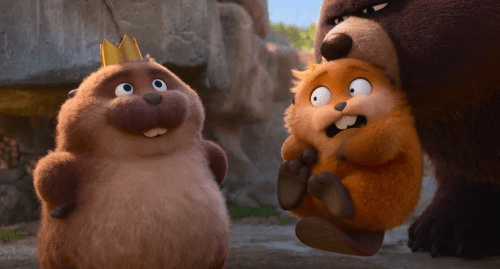
Mabel discovers a society as complex as our own, though several degrees more cutthroat, which is sensible, considering it’s a world of animals. They even have a type of government in the form of “pond rules,” the bluntest of which is that any animal can and should be eaten by whatever resides above them on the food chain—and both participants in that exchange fully understand that. It’s also sort of a monarchy, in that the surrounding mammals have anointed George (voice of Bobby Moynihan), the exact beaver Mabel is looking for, as their king.
It doesn’t take too much convincing to get George on board with the plan to get back at the mayor, though the movie’s plot is taken up with the various conflicts that threaten to stop the plan in its tracks. The first is that Jerry has gone to great, potentially illegal lengths to ensure that the beltway is built on land with no wildlife. The second lies in the other external conflict here, which is that Mabel unintentionally causes a political disaster within the whole of the animal kingdom when a rare meeting between the different figures of “royalty” commences and, well, goes horribly awry.
Not much should be said about this portion of the film, of course, because it gets into the weeds on that twisted third act that occasionally dips into horror territory. Let’s only say that it involves the queen butterfly (voiced by Meryl Streep), her caterpillar son after he pupates (voiced by Dave Franco), and a newfangled robot with a dreadfully familiar appearance. Again, that’s all that should be said, because the ensuing chaos is both spectacularly funny in a very dark way and also pointed in the way it tears political grandstanding a new one in the process.
The film, though, ultimately comes back around to a very touching conclusion to this whole thesis and essay, and that’s because Andrews and director Daniel Chong have—despite how everything sounds from what’s been described above—so carefully prioritized these characters. Hoppers is another true winner from an animation studio that, for the first time in a while, feels truly focused on what matters about their latest concoction.
Rating: ***½ (out of ****)

 Joel on Film
Leave a comment