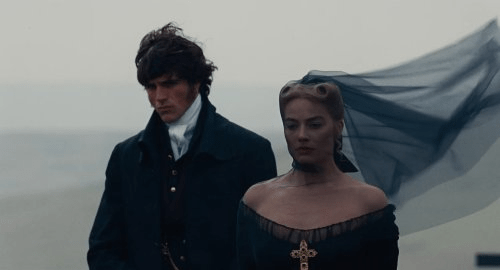
There are a few ways to read the central romance in Wuthering Heights, a lushly crafted and photographed adaptation of Emily Brontë’s classic (and only) work of Gothic literature, and it seems that writer/director Emerald Fennell has chosen the more generous one. It is true that the filmmaker acknowledges the toxicity of the character known as Heathcliff, especially visible during a minor subplot in which the former stable boy—now a figure of wealth and status—takes a lover with the stated purpose of doing so as vengeance. There are other signs, though, that Fennell sort of misses the straightforward point of this telling of the story.
It’s also important to realize that this is not at all a faithful rendition of the novel, which was told from an entirely different perspective and with a framing device (as well as a climax) that Fennell entirely excises. In theory, that’s fine: no filmmaker promises adherence to source material, be it real life or even a truly fine novel, and we shouldn’t ask that they start now. There is a difference, though, between creative liberty and intentional ignorance, and the movie that has been made here is barely an adaptation of the novel (which likely explains the stylized title appearing within quotation marks).
Anyway, the movie still is about the star-crossed and alleged love between Heathcliff and Catherine Earnshaw, the woman who as a child (played by Charlotte Mellington) gave her “pet” (played as a boy by Owen Cooper) that name in remembrance of a late brother. As adults, Catherine and Heathcliff are played by Margot Robbie and Jacob Elordi, but by far the more interesting performance of the two comes from the latter, who is allowed to be his own towering height and somehow captures the dichotomy within this character between two timelines. The first is during the early years, as Heathcliff embodies exactly what Catherine wants in a man.
The second is several years later, after Catherine has married a wealthy merchant because of the societal expectations of a woman of her status and not because she loves him (Hong Chau plays Nellie, a hired companion from childhood whose role here evolves in importance but never quite rises to more than a plot device). No, her heart obviously belongs to Heathcliff, until a misunderstanding, which is the result of a petty intentional act, leads him to believe she’s bought into a structure they both know to be a lie. Upon his return, Heathcliff has accrued a great amount of wealth and formulated a plan, either to win Catherine back or to embarrass her greatly.
The entire dynamic of this relationship, then, is toxic to its very core, and the shift in Elordi’s performance, from besotted and uncertain of how to move forward to cunning about the ways in which he might insert himself into her boring but comfortable new life, is thoroughly convincing. In that subplot, he takes advantage of a crush in the form of Isabella (Alison Oliver), the young and impressionable ward of Catherine’s new husband Edgar (Shazad Latif). The lengths to which he goes to avenge his formerly beloved Catherine’s pursuit of other options is fairly disturbing, although Oliver is truly great here, adopting a quivering voice and a delicate posture that both belie an infernal desire to be dominated.
The production is an exquisitely handsome one, with art direction and costume design and the score and even the soundtrack (Charli XCX provides original songs that act more as atmosphere than addendum—except the most prominent one, which just ends up scoring a montage) all firing on every cylinder. Cinematographer Linus Sandgren clearly understands how to utilize both color and shadow to say something about the characters and their relationship with the opulent surroundings. It’s all a little too much, ultimately, for what amounts to a melodrama.
At least, that’s the impression given by the whole of Wuthering Heights, which tells us in every moment exactly how we’re supposed to feel about all this. If we feel nothing, it’s only because, out of the handful of options for how to read this romance, Fennell has avoided the one that might genuinely probe the two participants, in favor of, well, a tragically romantic and, therefore, utterly shallow view.
Rating: ** (out of ****)

 Joel on Film
Leave a comment