Director Nia DaCosta’s 28 Years Later: The Bone Temple almost assuredly does not stand alone, having been filmed and produced right alongside 2025’s 28 Years Later and arriving in theaters less than a year later. What DaCosta, given the unenviable task of taking over this story from Danny Boyle, proves is that the film doesn’t necessarily need to stand alone. The pieces were present in and mostly suggested by that earlier film—the first of a proposed trilogy that continues with this one, to be followed shortly by the third installment—are all on display here, finding an infection-ravaged world disappearing into a murky and blurry existence fully predicated upon the twisted tenets of a poisonous religion.
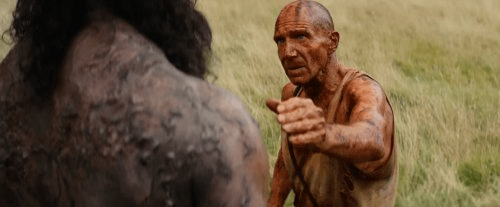
Perhaps by virtue of having been directed by Boyle, who had returned to the franchise 22 years after 2003’s 28 Days Later (still a phenomenally terrifying vision, by the way), this installment also repeats some of the ideas we know by now, particularly as it regards the character of Dr. Ian Kelson (Ralph Fiennes). His presence here is defined by the dichotomous relationship with a Satanic zealot played by Jack O’Connell, whom we had briefly met at the very end of the last adventure. Kelson still seeks a cure or some form of treatment for the Rage Virus, and his experiments mainly involve an infected known as Samson (Chi Lewis-Parry), whose eyes bulge and whose skin has become mottled by the mysterious disease.
The zealot, known as Sir Lord Jimmy Crystal (a bit extravagant, that), also operates as a kind of cult leader for the Fingers, all of whom don blond wigs and are named Jimmy in the image of their lord. As the film opens, perhaps just hours after the previous one ended, they had ensnared Spike (Alfie Williams), the young boy whose mother had fallen victim to the disease in the final scenes of the last movie. That led, if one recalls, to a ritual as devastating as it was purely unsettling, considering it involved finding out the practical reason for a mass pile of skulls at the center of a makeshift temple (hence the subtitle of this follow-up).
The leader Jimmy believes his father to be Satan himself, and when one of his handful of followers, a woman played by Erin Kellyman, misconstrues something through a pair of binoculars, she convinces Jimmy that Kelson—doused as he is in skin-reddening iodine, to ward off infection—is the fallen angel out of Biblical lore. An ensuing conversation, thrilling because we get to see the fine and opposing performances from O’Connell and Fiennes bounce off each other, results in an agreement that benefits both of them. Jimmy will be able to keep up the charade of his “charity” work, and Kelson will be allowed to live.
This is a thoughtful movie, beneath all the graphic horror violence (heads that are not simply removed but pulled out along with much of the spinal cord, as just one example) that results from the virus and the characters’ attempts to escape those infected with it. The visual grit remains, even as DaCosta and cinematographer Sean Bobbitt likely did away with the jazzed-up cell-phone photography of the last movie, and in collaboration with editor Jake Roberts, such scenes combine expertly devised horror beats with punchy action edits that are consistently exciting, bordering on thrilling. It certainly helps that the narrative brings us in directions that are impossible to predict merely on the basis of being a companion piece.
A lot of that has to do with the return of Alex Garland, who thankfully did not delegate duties to another screenwriter but gave us a considered and concise new path for this story. It wouldn’t be too accurate to say that the movie represents a new chapter in that story, since so much of our understanding its various narrative developments relies upon our familiarity with the last installment. One also supposes that such familiarity with help comprehending the next movie, too, although the return of a familiar character and a newfound sense of readiness in the final moments here might be enough to offset that need.
The movie’s ideas do eventually simplify to the degree that its ritual-heavy climax (including a most unexpected, but fully justified, Iron Maiden needle-drop) comes across as a way of the film’s heroic individual(s) looking for a way to outwit the primary antagonist of the piece. It’s a little less ambitious than the concept of letting those ideas guide the genre elements, instead of the other way around, but there’s also a satisfying closure that ensures this doesn’t only feel like a stepping-stone movie in a franchise. Even that final scene’s promise doesn’t entirely dispel the fear that this franchise will end on a particularly happy note.
In other words, 28 Years Later: The Bone Temple cannot stand on its own by design, because the pieces of what came before, in order to make sense of what will come later, need what happens now for them to fit. Perhaps that makes this a particularly importance stretch within the body of an essay, rather than merely a puzzle to be constructed.
Rating: *** (out of ****)

 Joel on Film
Leave a comment