It is easy to forget, at least for those not directly affected by them, all the regional conflicts around the world, and the one in Syria, which raged particularly violently in the 2010s, might have been swallowed up a little, in terms of media coverage, in the wake of another, more recent conflict to the southwest of that country. Here, though, is I Was a Stranger, which seeks to dramatize the story of the refugees from Aleppo in a particularly elaborate way. Writer/director Brandt Andersen has woven a series of interlocking stories, all kind of (but not really) recounting how one woman—who comes to represent a lot of real women, one supposes—might have found her way from the war-torn country to a major hospital in Chicago.
This is an ambitious idea, surely, but Andersen’s ambitions are limited entirely to the method of storytelling here, losing along the way the actual humanity of the story (or, really, stories) being told. On an inherent level, then, we can sympathize with the story of Amira Homsi’s (Yasmine Al Massri) survival instincts and her hard work to protect her daughter Rasha (Massa Daoud). In practice, though, the film just splits its focus too much and onto so many characters and secondary conflicts that we’re hard-pressed to care about the story on a more specific level.
There is, after all, a difference between the well-meaning ambitions of a movie and the result of the filmmakers’ efforts, and as the latter is far more important—at least, in most cases and with few exceptions—it’s where Andersen falls quite short. The first sign of something amiss is that the whole of the story is framed as a memory of sorts, finding Amira at that big-city hospital and realizing that today is the anniversary of the events that led to her escape. Such framing devices are inherently lazy, but this one doesn’t even make much sense within the context of what Andersen is trying to pull off.
If the movie is a memory, why does the ensuing narrative fraction itself into chapters, each following a separate character in the surrounding story? Some of these perspectives cannot possibly have been relayed to Amira—especially one of them, which is punctuated by violence as a kind of gasp-worthy cliffhanger. Others likely would have been, of course, but right from the start, the filmmaker undermines both acts of narrative gimmickry, a term that rather perfectly describes what is, fundamentally, at play in this case.
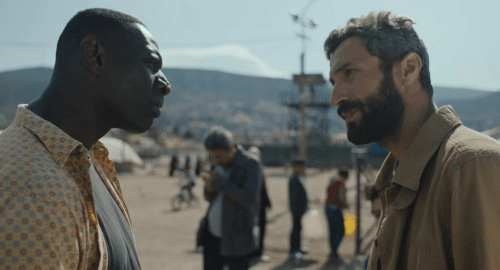
The setting of the film-long flashback is Aleppo in the year 2015, under the brutal regime of Bashar al-Assad, and fleeing the place on a boat to Greece, where a friendlier government might offer them asylum or a path elsewhere. The other characters include the likes of a poet named Fathi (Ziad Bakri), who escapes at the same time Amira does and is accompanied by members of his family, and Mustafa (Yahya Mahayni), a soldier in Assad’s army expected to follow orders, no matter how ruthless, but recently coming to question his role. There are also Marwan (Omar Sy), whose job to smuggle refugees to safety is just a source of income, and Stavros (Constantine Markoulakis), a ship’s captain alerted to the refugees’ arrival on a small boat to safety.
Every character—including, unfortunately, Amira, who witnesses the bombing death of most of her family in an early scene—exists at the service of Andersen’s chosen storytelling structure, which is to present events as overlapping by picking up at a certain point with each of them and all stopping at the same point near the climax. Some moments are dreadful in their power, like a checkpoint stop that tests Mustafa’s resolve and ends in a genuinely surprising and upsetting murder, but others are simply confounding. The entire thread following Marwan, for instance, seems to have been devised so that a gun-wielding standoff can cut off at precisely the moment of pay-off, while the outcome of the rescue seems to gloss over a lot of the bleak realities of what follows for these people.
This is a bleak movie, about an important period in history, but it only scratches the surface of its own fictional narrative, without much courage or conviction to dig into the reality of its inspiration. I Was a Stranger simplifies this terrible recent history in the process of trying to transform it into a creative writing exercise.
Rating: ** (out of ****)

 Joel on Film
Leave a comment