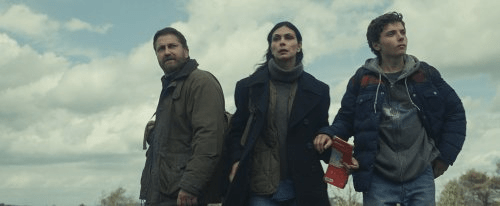
“You’ve gotta be kidding me,” says our protagonist at a crucial point in the journey to southern France, which makes up the plot of Greenland: Migration. Indeed, it does seem like a bit of a bad joke on the part of the screenplay that John Garrity (Gerard Butler), his wife Allison (Morena Baccarin) and their son Nathan (now played by Roman Griffin Davis) are in the precarious position—literally—in which they have found themselves at that moment. They’ve just crossed a particularly narrow bridge and reached the halfway point across a canyon, on the other side of which is the possibility of survival.
It would be wrong to reveal what exactly happens in this scene, if only because it’s one of the few examples of developments that could be called a “spoiler,” but let’s just say that it’s quite the contrivance that screenwriters Mitchell LaFortune and Chris Sparling (the latter returning 2020’s Greenland) have devised in order to push the drama of this whole scenario even further. If we’re to take such plot developments seriously within the context of existentialism, one might even call it a curse that follows the Garrity family wherever they go. How else could we explain all the potentially fatal stuff that these three narrowly escape, often at the expense of others in their company?
For such a somber movie, then, there is a lot of silliness in returning director Ric Roman Waugh’s film, which picks up five years after a comet broke apart in Earth’s upper atmosphere and decimated a good portion of the planet and its inhabitants. That earlier movie did a serviceable job at giving us yet another disaster movie, going smaller than most but, ultimately, reducing itself to a lot of the same, old tropes that every other disaster movie has given us and falling just short of offering anything new or exciting. The big question entering this unlikely and unnecessary sequel is what story could be told beyond that fairly self-contained one.
The answer, as this movie consistently proves to us, is not much. To an even greater degree than the last film, which was solely about the Garritys trying to get on a flight to the base in Greenland where survivors might flourish, a single-minded narrative is the name of the game here. The base, which resides underground and is under constant threat of destabilization, is no longer enough of a shelter, but as scientist Casey Amina (Amber Rose Revah) informs them, there might be a chance in the many-miles-wide crater that marked the impact of the comet.
It’s a road movie again, in other words, or at least, the narrative depends upon constant travel for the family of three, each of whom has had to adjust in their own way to a new life: John makes regular trips outside, where electrical storms arrive quickly and devastate whatever lay in their path, and affected his good health in the process. Allison is now part of a semi-governmental infrastructure whose job it is to hold a vote on any major decisions—such as welcoming new survivors into their carefully orchestrated surroundings—and abide by that vote at all costs. Nathan has been forced to enjoy his youth inside these walls but just wants to go outside with his classmates.
Waugh and the film’s visual effects artists have crafted a believable and sometimes haunting dystopia here, as the hills and forests of the outside world have been drained of color and life and the city of Liverpool, an unintended pause in their journey, is fully submerged in water. There are also striking singular set pieces here, like a violent and intense shootout from each side of a steep hill, through which our heroes must sally forth in the direction of oncoming bullets. Then again, there’s also the bit with the rickety bridge, which is followed immediately by another makeshift one consisting of ladders, that strains both credulity and logic in a way that cannot and should not be excused by this just being a movie.
Things just sort of happen in this sequel, basically, and though the filmmakers attempt to communicate the bleakness of the situation (a pair of stops, including to visit an old ally played by Sophie Thompson and a late diversion to pick up a new passenger, just as the movie is about to end, are both about how it might be a better idea to set down roots while you can), the foundation simply isn’t there for whatever they were trying to accomplish here. Greenland: Migration mostly resonates as a way to give its predecessor a sequel, but it didn’t bother to pause and ponder whether that was even a worthwhile idea.
Rating: ** (out of ****)

 Joel on Film
Leave a comment